Blog
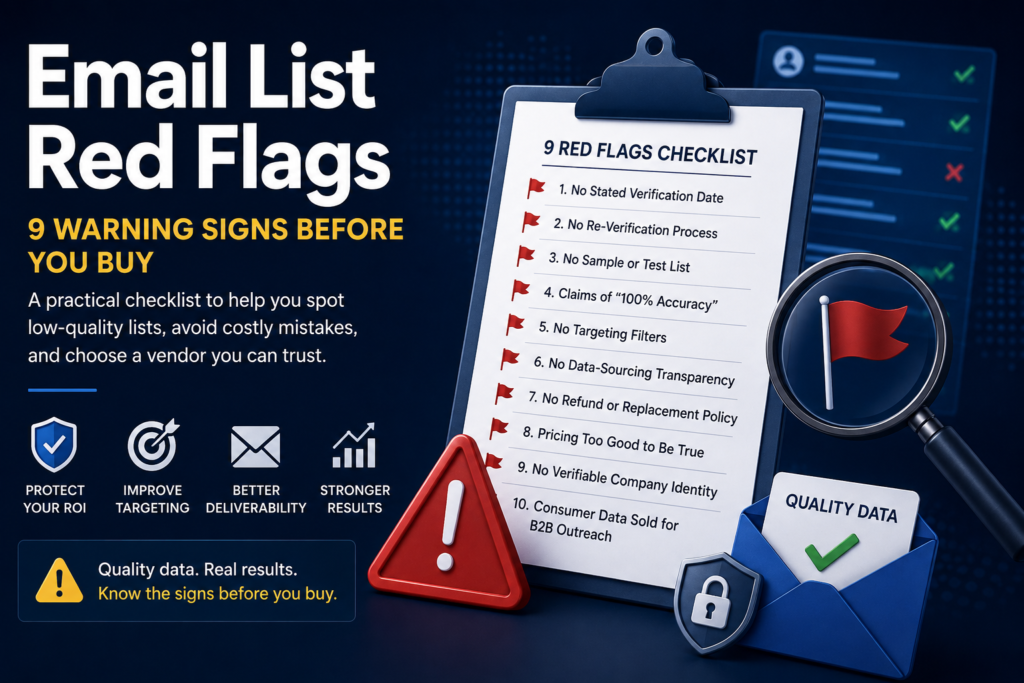
Six checkable signs can predict a bad email list purchase before you spend a dollar: no verification date, no sample offered, “100% accuracy” claims, no targeting filters, no compliance documentation, and no refund policy. If several of these appear together, walk away and keep looking.
Why This Matters Even If Buying a List Is Legal
Many buyers focus on one question before purchasing a list:
“Is this legal?”
That’s an important question, but it’s only part of the picture.
A list can be legally sourced and still be a terrible purchase.
Legal compliance does not automatically mean the data is accurate, relevant, or useful for your business. A list may be legally collected but still contain outdated contacts, inactive email addresses, poor targeting, or information that no longer matches your ideal customer.
In other words, legality and quality are two different things.
A company can sell a list that technically complies with applicable regulations while still delivering data that produces high bounce rates, low engagement, and poor campaign results.
This guide focuses on data quality signals, not legal requirements. If you want to understand the legal side of purchasing and using email lists, see our detailed guide on email-list compliance and regulations.
The goal here is simple: learn how to identify warning signs before you pay.
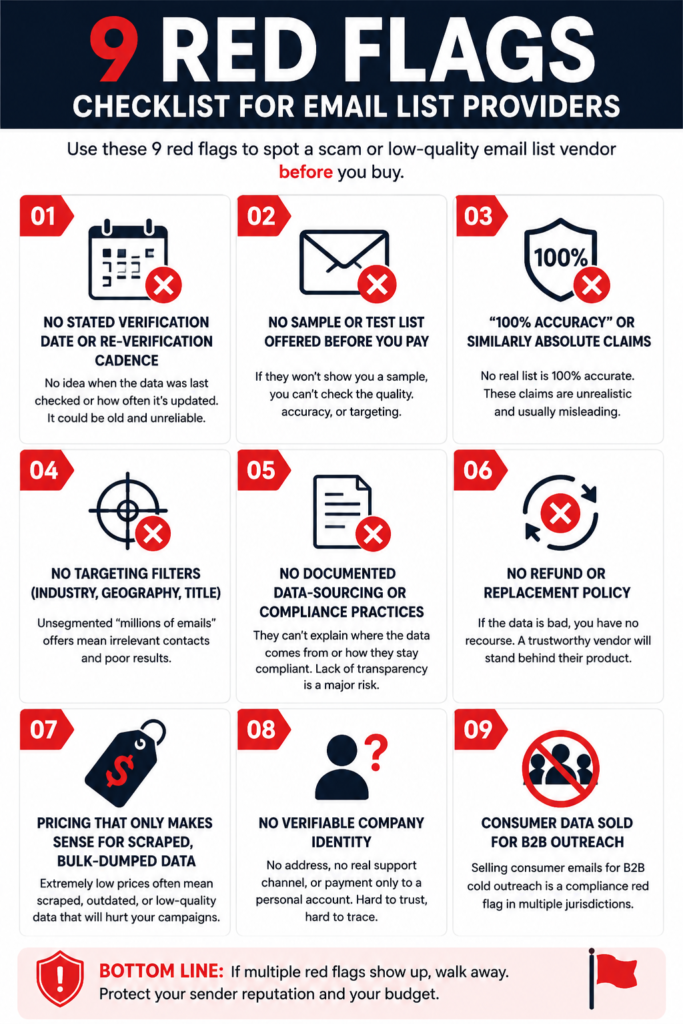
The 9 Red Flags Checklist
The easiest way to avoid a bad purchase is to know what warning signs to look for.
A single red flag may not always mean a vendor is dishonest. However, multiple red flags appearing together usually indicate poor-quality data or questionable business practices.
1. No Stated Verification Date
A trustworthy vendor should be able to tell you when the list was last verified.
If a provider cannot explain when the data was checked—or avoids the question entirely—you have no way of knowing whether the information is current.
Email data becomes outdated surprisingly quickly. People change jobs, companies close, and domains expire.
If there is no verification date, assume the data may be stale.
2. No Re-Verification Process
Verification should not happen once and then be forgotten.
Good vendors regularly re-verify their databases and can explain their process.
Ask how often records are reviewed and updated.
If the answer is vague or unclear, that’s a warning sign.
3. No Sample or Test List Offered
Reputable vendors are usually willing to provide a small sample before purchase.
A sample allows you to review:
- Data quality
- Record completeness
- Targeting accuracy
- Overall fit for your campaign
If a vendor refuses every request for a sample, ask why.
Sometimes there may be a legitimate reason, especially for highly specialized custom segments, but in most cases, a sample helps build trust.
4. Claims of “100% Accuracy”
This is one of the easiest red flags to spot.
No email list is 100% accurate.
People change jobs every day. Businesses rebrand. Domains expire. Contact information changes constantly.
Responsible vendors understand this reality and set realistic expectations.
Any provider promising “100% accuracy,” “zero bounces,” or “perfect data” is making a claim that simply isn’t possible.
5. No Targeting Filters
Be cautious when a seller advertises:
- Millions of email addresses
- Massive databases
- Every industry included
- Every business included
Quantity sounds impressive until you realize most of those contacts may be irrelevant to your business.
A quality provider should offer filtering options such as:
- Industry
- Job title
- Company size
- Geography
- Revenue range
- Technology usage
Without segmentation, you’re paying for volume rather than relevance.
6. No Documented Data-Sourcing or Compliance Practices
A trustworthy vendor should be able to explain where the data comes from and how it is maintained.
You don’t necessarily need every technical detail, but there should be a clear explanation of the collection process.
If a provider refuses to discuss sourcing methods or cannot explain how records enter the database, proceed carefully.
Transparency matters.
7. No Refund or Replacement Policy
Even high-quality data occasionally contains outdated records.
That’s normal.
What matters is how the vendor handles problems.
A reputable provider should have a written policy explaining:
- Replacement records
- Bounce guarantees
- Eligibility requirements
- Resolution procedures
If the answer is simply “all sales are final,” think twice before purchasing.
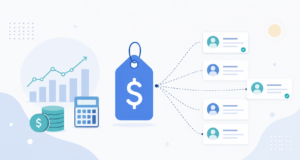
8. Pricing That Looks Too Good to Be True
Quality business data requires collection, maintenance, verification, and support.
Those activities cost money.
If one vendor offers a targeted business list for a fraction of the market price, ask yourself why.
Extremely cheap databases are often:
- Scraped from public websites
- Outdated
- Duplicated
- Resold repeatedly
- Poorly maintained
Low price alone doesn’t prove poor quality, but unusually cheap offers deserve extra scrutiny.
9. No Verifiable Company Identity
Before purchasing, verify that the company actually exists.
Look for:
- A business address
- A company website
- Customer support channels
- Business email addresses
- Public company information
Be cautious if:
- There is no business identity
- Support is unavailable
- Communication happens only through messaging apps
- Payment is requested through a personal account
Legitimate businesses do not hide who they are.
10. Consumer Data Being Sold for B2B Outreach
This issue deserves special attention.
Business outreach and consumer marketing are governed by different rules in many jurisdictions.
If a vendor is selling consumer email data specifically for B2B cold outreach, that should raise immediate questions.
Beyond quality concerns, this can create compliance risks depending on where you operate and where recipients are located.
Treat this as both a quality warning and a potential legal warning.
What a Trustworthy Vendor Looks Like
The easiest way to evaluate a provider is to reverse the red-flag checklist.
A trustworthy vendor should be able to demonstrate:
A Clear Verification Process
They can tell you:
- When data was last verified
- How verification occurs
- How often records are updated
A Sample You Can Review
You should be able to evaluate data quality before making a large purchase.
A sample helps both parties confirm the list is a good fit.
Clearly Defined Data Fields
The vendor should explain exactly what information is included.
For example:
- First name
- Last name
- Job title
- Company name
- Business email
- Industry
- Location
You should know what you’re buying before you pay.
Documented Collection Practices
Professional providers can explain how records enter their database and how they maintain data quality over time.
Transparency builds trust.
A Refund or Replacement Policy
No provider can promise perfection.
However, they should explain what happens if delivered data fails to meet stated quality standards.
Meaningful Segmentation Options
Good targeting matters.
A quality vendor should allow filtering by relevant business criteria rather than forcing you to buy an unfiltered bulk database.
A Real Company Behind the Product
You should be able to verify:
- Company identity
- Contact information
- Customer support
- Business presence
Trustworthy providers do not hide behind anonymous websites.
5 Questions to Ask Before You Pay
If you’re evaluating a vendor, these five questions can reveal a lot in just a few minutes.
1. When Was This List Last Verified?
A clear answer indicates the vendor actively maintains its data.
A vague answer usually indicates the opposite.
2. Can I Get a Sample to Test First?
A sample helps you evaluate quality before committing to a larger purchase.
3. What’s Your Bounce-Rate Guarantee?
Every vendor should be willing to discuss expected data quality.
4. What Happens If the Bounce Rate Exceeds That Guarantee?
The answer should include a clear replacement or resolution process.
5. Is This List Exclusive or Sold to Multiple Buyers?
Some databases are sold repeatedly.
Others are built specifically for individual buyers.
Understanding the difference helps set expectations about competition and market saturation.
Red Flags vs. Deal-Breakers
Not every warning sign means you should immediately walk away.
Some issues simply require clarification.
Yellow Flags
These deserve additional questions:
- No sample offered on a very small custom segment
- Limited filtering options in a niche industry
- Slightly lower-than-average pricing
- Newer companies with limited public history
Sometimes there are reasonable explanations.
Ask questions first.
Deal-Breakers
These should usually end the conversation immediately:
- No refund or replacement policy
- No verifiable company identity
- Claims of 100% accuracy
- Refusal to discuss data sourcing
- Requests for payment to personal accounts
- Consumer data marketed for B2B cold outreach
When these issues appear, the safest decision is usually to find another provider.
Frequently Asked Questions
How Do I Know if an Email List Is Legit?
A legitimate list provider can explain its verification process, offer meaningful targeting options, provide clear company information, and explain how data is maintained. Transparency is usually one of the strongest indicators of quality.
What’s a Normal Bounce Rate for a Purchased List?
The benchmark should match your broader email strategy: under 2% hard bounces. Anything higher should trigger re-verification before additional sending.
Should a Vendor Offer a Free Sample?
In most situations, yes. A sample allows buyers to evaluate data quality and targeting before making a purchase. While some custom-built segments may have limitations, reputable vendors generally provide a way to review data before payment.
Is a Lower Price Always a Red Flag?
No. Lower pricing alone does not automatically mean poor quality. However, extremely cheap databases often deserve additional scrutiny because quality data requires ongoing maintenance, verification, and support.