Blog
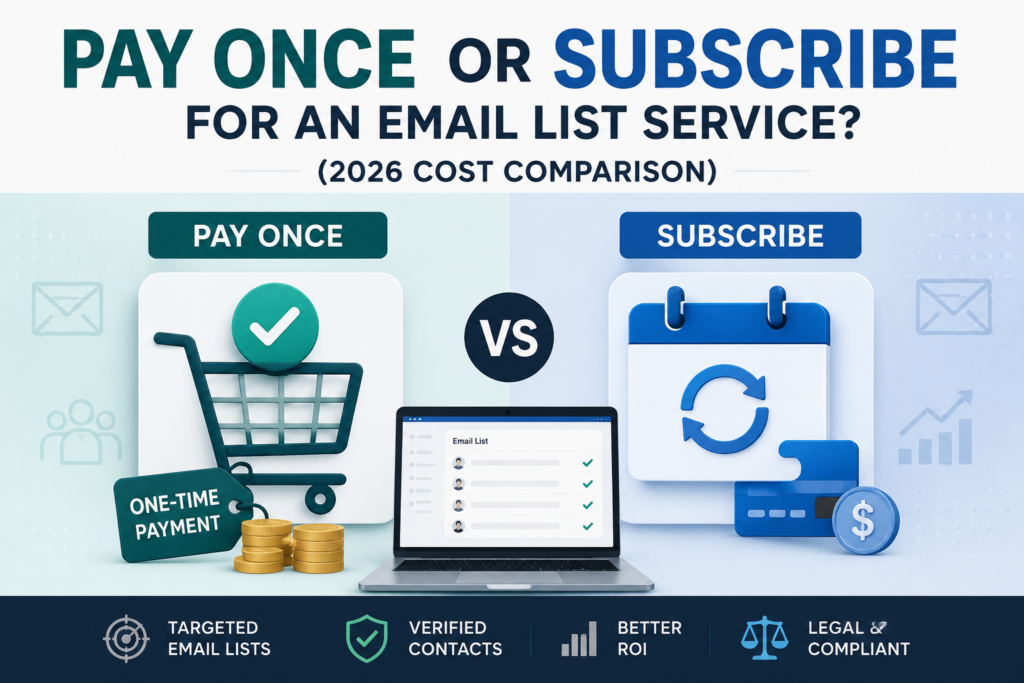
Quick answer: Pay Once or Subscribe for an Email List Service? For most small businesses and freelancers, choosing a one-time email list purchase is more cost-effective: you pay once (from $99 at EmailProLeads) and own the data, while subscription data platforms like ZoomInfo cost $1,200–$3,000+ every year. Subscriptions make sense only if you need continuously refreshed data at enterprise scale.
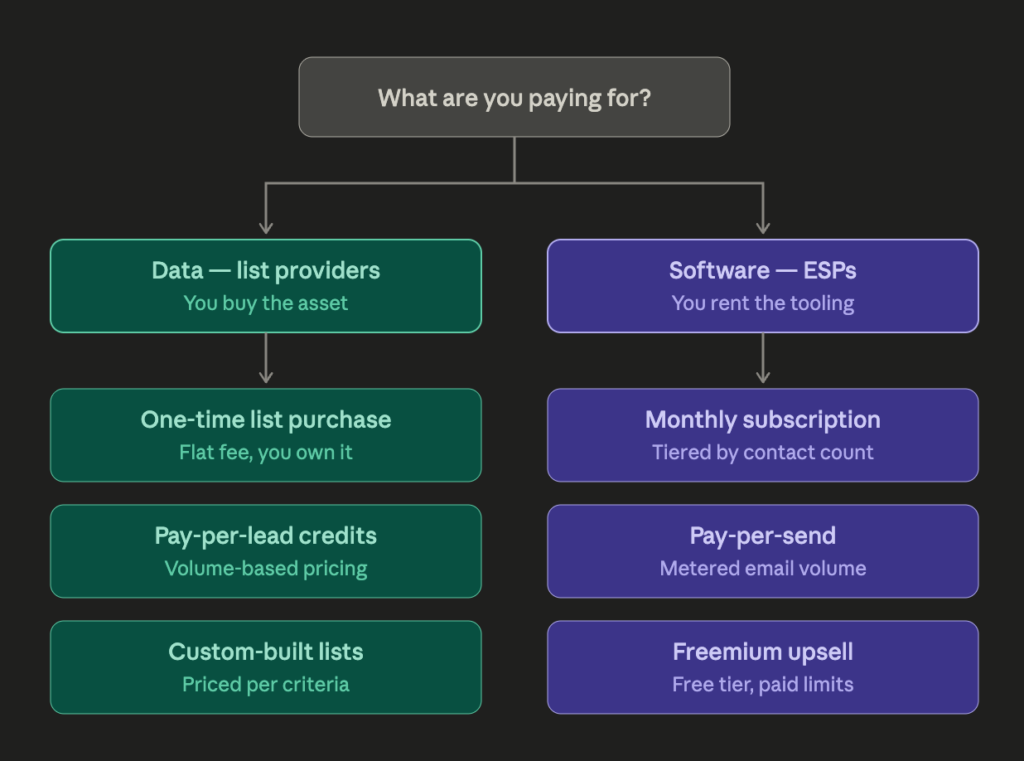
“Email list service” means two different things — and the right payment model depends on which one you’re buying:
- Email list providers (lead databases): sell you the contact data itself — verified B2B or B2C email addresses you export and own. This is what EmailProLeads does.
- Email marketing software (ESPs): tools like Mailchimp or MailerLite that send campaigns to a list you already have. Most are subscription-only; self-hosted tools like Sendy or MailWizz offer one-time licenses.
This guide covers both, but focuses on the decision that hits your budget hardest: how you pay for the data.
Pay Once or Subscribe for an Email List Service? : Side-by-Side
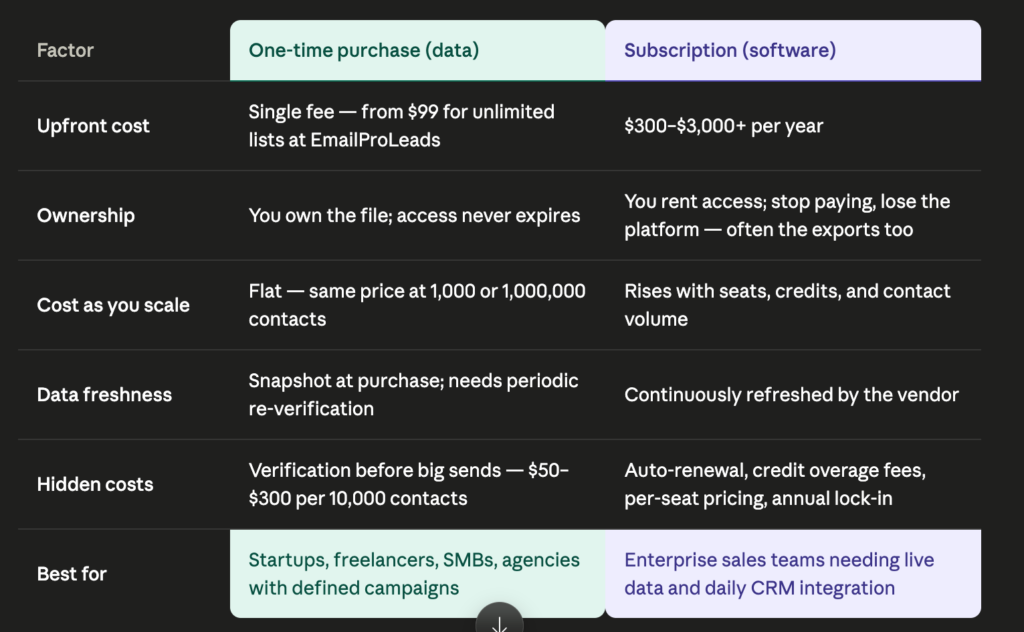
- Upfront cost: One-time = single fee (from $99 for unlimited lists at EmailProLeads). Subscription = $300–$3,000+ per year.
- Ownership: One-time = you own the file, access never expires. Subscription = you rent access; stop paying, lose the platform — and often the exports.
- Cost as you scale: One-time = flat, whether 1,000 or 1,000,000 contacts. Subscription = rises with seats, credits, and contact volume.
- Data freshness: One-time = snapshot at purchase, needs periodic re-verification. Subscription = continuously refreshed by the vendor.
- Hidden costs: One-time = verification before big sends ($50–$300 per 10,000 contacts). Subscription = auto-renewal, credit overage fees, per-seat pricing, annual lock-in.
- Best for: One-time = startups, freelancers, SMBs, agencies with defined campaigns. Subscription = enterprise sales teams needing live data and daily CRM integration.
The 5-Year Math: What Each Model Really Costs
Subscription pricing looks small monthly — and enormous cumulatively. Using published pricing for popular data platforms:
- EmailProLeads Lifetime Plan — One-time — Year 1: $99 — 5-Year Total: $99
- Adapt — Subscription — Year 1: $300+ — 5-Year: $1,500+
- Snov.io — Subscription — Year 1: $340 — 5-Year: $1,700
- Lusha — Subscription — Year 1: $349 — 5-Year: $1,745
- ZoomInfo — Subscription — Year 1: $1,200–$3,000+ — 5-Year: $6,000–$15,000+
Even after adding periodic re-verification of a purchased list (budget $50–$300 per 10,000 contacts, once or twice a year), the one-time model stays a fraction of subscription cost for the first several years.
The Honest Weakness of Pay-Once Lists: Data Decay
- B2B contact data decays at roughly 2–3% per month as people change jobs — a static list loses meaningful accuracy within a year.
- Continuous refresh is the real thing subscription platforms sell. Be clear-eyed about that.
- The one-time workaround: re-verify before major sends, remove bounces after each campaign, refresh the segments you actively work.
- If your outreach is continuous, high-volume, and market-wide, decay math can favor a subscription. For defined campaigns against a known audience, it rarely does.
Renewals, Cancellations, and Switching Between Models
Three contract details cost subscription buyers the most money:
- Auto-renewal: most annual data contracts renew automatically unless cancelled 30–60 days before term end. Diary the date the day you sign.
- Credit expiry: unused monthly credits usually expire. You pay for capacity, not usage.
- Export limits on exit: some platforms restrict bulk export precisely so leaving is painful. Check the export clause before you buy.
A one-time purchase has none of these — nothing to renew, nothing to cancel, file already exported. Switching is also one-directional: buying a list outright today and adding a subscription later is easy. Cancelling a subscription and keeping usable data is much harder.
Which Model Fits You? Decision Matrix
- Freelancer / solopreneur, a few campaigns → One-time. No recurring overhead; spend is controlled per project.
- Small business entering a new market → One-time. Buy a targeted segment, test, re-buy only if it works.
- Agency running lists for multiple clients → One-time (unlimited-list plan). A flat lifetime plan beats per-seat, per-client subscription pricing.
- Enterprise SDR team, daily prospecting, CRM-integrated → Subscription. Live refresh and integrations justify the annual cost at scale.
What About Email Marketing Software?
- If your question was about the sending tool, not the data: Mailchimp, MailerLite, and similar ESPs are subscription-only, priced by subscriber count — a 10,000-subscriber list commonly costs $50–$100+ per month.
- One-time alternatives exist: Sendy, MailWizz, and other self-hosted tools, typically $69–$250 once plus ~$0.10 per 1,000 emails via Amazon SES.
- The catch: you need basic server setup skills.
- Same logic as data: pay-once wins on long-run cost, subscriptions win on convenience.
FAQ
Q: Is it better to Pay Once or Subscribe for an Email List Service?
A: Pay once if you want to own your data and control costs — typical for startups, SMBs, and agencies. Subscribe only if you need continuously refreshed contact data every day at scale.
Q: Are there reliable email list services with a one-time fee?
A: Yes. EmailProLeads offers a one-time Lifetime Plan from $99 with verified, deduplicated, regularly cleaned lists across worldwide markets — replacing subscription tools that cost $2,000+ per year combined.
Q: Are there hidden costs with one-time email lists?
A: Budget for email verification before large sends ($50–$300 per 10,000 contacts) and expect to refresh segments you use heavily. There are no renewal, seat, or credit fees.
Q: Can I switch from a subscription to a one-time purchase?
A: Yes — and it’s the easy direction: buy your target segments outright, cancel the subscription at term end, and keep working from data you own.
Q: How much is an email list worth?
A: Market rates run $100–$400 per 1,000 contacts for consumer lists and $300–$1,000+ for B2B — see our full breakdown.
Q: Is buying an email list even legal?
A: In the US, yes — buying lists is legal, and CAN-SPAM regulates how you send. Full compliance guide here.