Blog
Quick answer: The 30/30/50 rule is a practitioner heuristic for where cold email results come from: roughly 30% list quality (right people), 30% offer strength (right message-market fit), and the rest execution — copy, timing, and follow-up. Its lesson: most senders over-invest in copy and under-invest in the list.
Note: this is a folk framework used by cold-email practitioners, not a formal standard — you’ll see slightly different splits cited. The consistent core across every version: targeting and offer matter more than clever copywriting.
Breaking Down the Three Parts
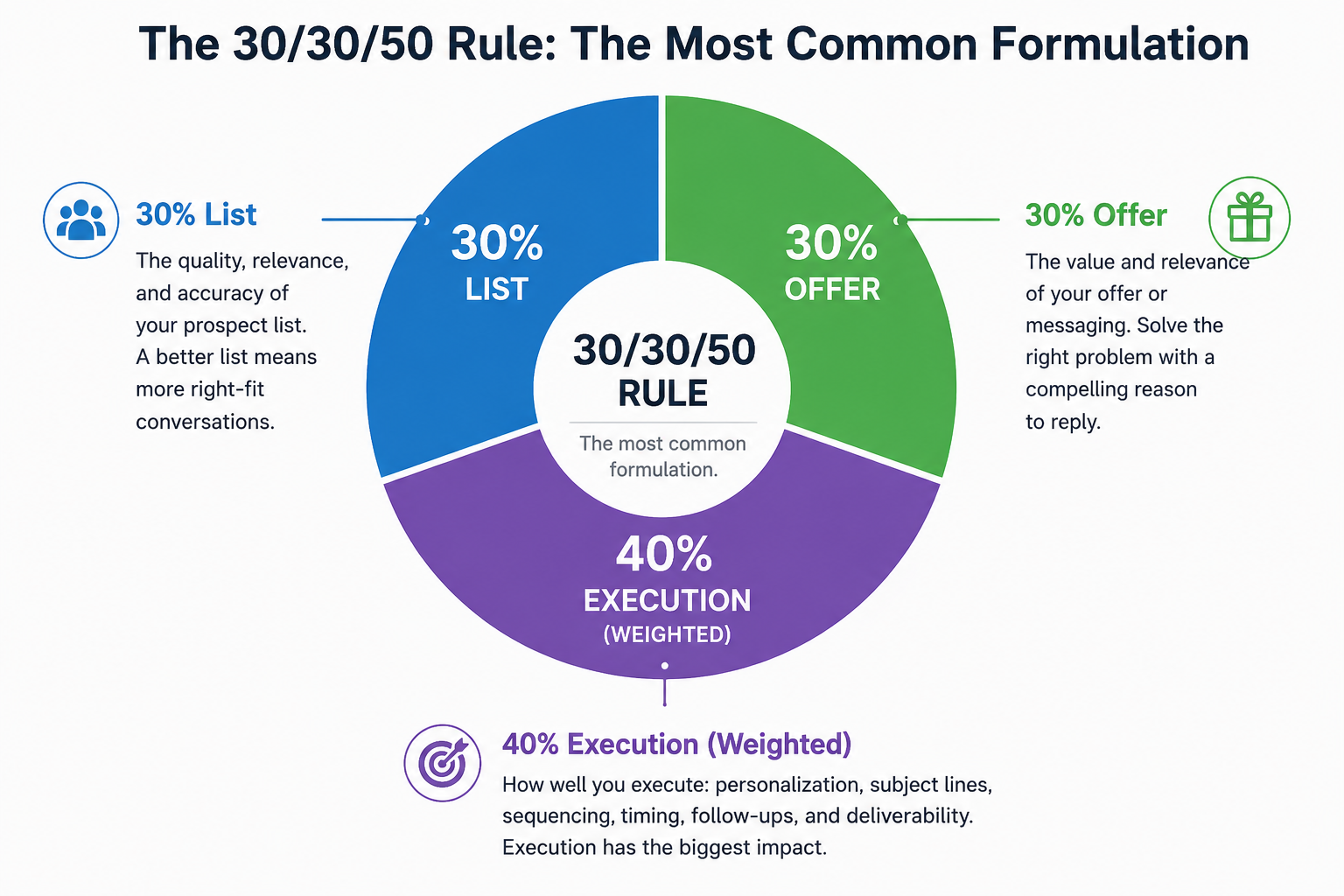
30% — The list
- No subject line rescues an email sent to the wrong person.
- List quality = verified addresses (protecting deliverability) + precise targeting: right title, right industry, right company size.
- This is why experienced senders spend real money on data before spending any time on copy.
30% — The offer
- The value proposition must be specific and relevant to the recipient’s role.
- “Book a demo” is not an offer. “We cut freight quoting time for 3PLs by 40% — want the 2-line summary?” is.
50%-weighted — Execution
- Copy, personalization, send timing — and, most underrated, follow-up sequencing.
- The majority of cold-email replies come from follow-ups, not the first message.
H2: The 60/40 Rule and the 80/20 Rule in Email
- 60/40 rule: keep emails 60% valuable content, 40% (or less) promotion. In practice most strong programs run closer to 80/20.
- 80/20 rule (Pareto): ~80% of email revenue comes from ~20% of your messages and segments — find and scale that 20%. Also used as a content ratio: 80% value, 20% pitch.
Is Cold Email Still Effective in 2026?
Yes — for senders who clear the modern bar:
- Gmail and Microsoft now enforce strict bulk-sender rules: SPF/DKIM/DMARC authentication, spam-complaint rates under 0.3%, one-click unsubscribe.
- That enforcement has actually improved results for disciplined senders by filtering out spray-and-pray competitors.
- What works in 2026: verified targeted lists, warmed dedicated domains, sub-200-word personalized emails, and 3–5 touch follow-up sequences.
- And no, cold emailing is not illegal — CAN-SPAM permits it with proper conduct. [INTERNAL LINK → /is-buying-email-lists-legal/]
H2: Applying the Rule: Start With the 30% You Can Buy Right
- Two of the three success factors — list and offer — are decided before you write a word.
- Get the list component right with verified, targeted data. [INTERNAL LINK → /targeted-email-list/]
- Deciding how to pay for that data? Here’s the one-time vs. subscription math. [INTERNAL LINK → /pay-once-vs-subscription-email-list/]
FAQ
Q: What is the 30 30 50 rule for cold emails? A: A heuristic attributing cold-email success ~30% to list quality, ~30% to offer strength, and the remainder to execution (copy, timing, follow-up).
Q: What is the 60/40 rule in email? A: Keep at least 60% of your email content genuinely useful and no more than 40% promotional.
Q: What is the 80/20 rule in email marketing? A: The Pareto principle: about 80% of results come from 20% of sends/segments — or, as a content guideline, 80% value to 20% promotion.