Blog
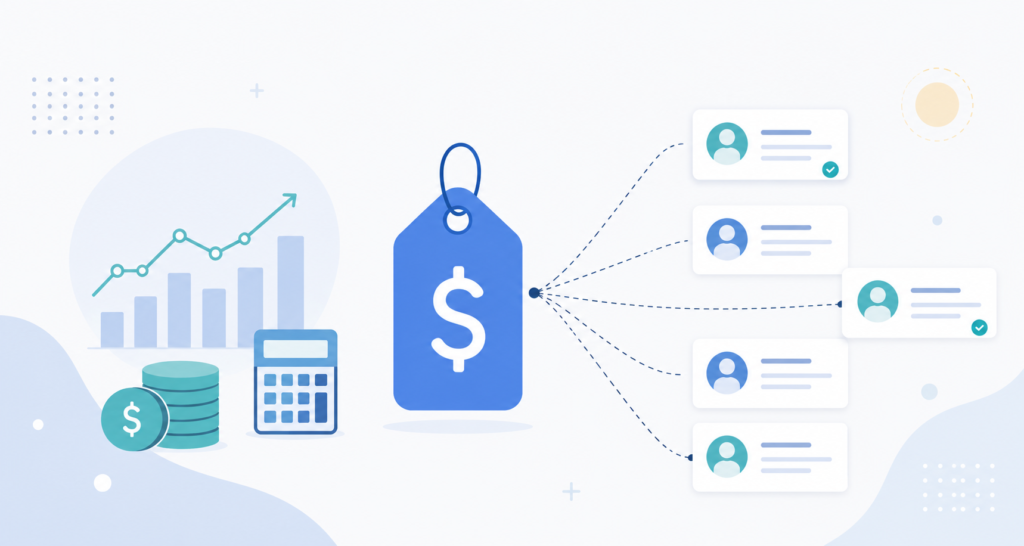
If you are thinking about buying business contacts, chances are the very first thing that you are going to wonder about is how much does email list cost? There will be many factors affecting the price – number of contacts, criteria of targeting, data quality, one-off purchases versus subscriptions, and many others.
Contacts you are going to purchase would usually cost you $0.01-$2.50 per record, depending on the level of verification, targeting, and the size of your order. Generated leads would usually cost somewhere between $30 and above $3,000 per record, depending on the industry and channel (advertising, cold prospecting, lead generation agencies). These are two completely different products, but they are often compared side by side, and understanding the distinction is key in evaluating the email list cost. It is important to know where exactly should you put your money and what you are really paying for.
In this article, we will cover the various models of pricing, factors influencing the email list cost, and show you the real prices for good quality B2B email list in 2026.
Why “cost per lead” numbers online disagree
If you’ve searched around for B2B lead pricing, you’ve probably noticed the numbers don’t line up. Belkins puts B2B cost per lead at $420 to $3,080. Apollo says $40 to $650+. Zeliq cites $30 to $200. First Page Sage’s widely cited benchmark study puts the average blended CPL around $237, with a range from about $91 to $982 depending on industry.
None of these sources are wrong. They’re measuring different things.
There are really two separate products hiding under the phrase “B2B lead”:
A purchased record is a name, title, company, and email address pulled from a database. Nobody did any work to generate interest in your product, it’s just a matching contact that fits your filters. This is what you get from a data provider like Apollo, Zeliq, or a list purchase. Priced per contact, usually a few cents to a couple of dollars.
A generated lead is a contact that came through active marketing or sales effort, someone who clicked an ad, filled out a form, replied to a cold email, or was contacted and qualified by an agency. This is what Belkins and First Page Sage are measuring. It includes the cost of the campaign, the ad spend, the copywriting, the follow-up, not just the contact info itself. Priced per acquired lead, usually tens to thousands of dollars.
Mixing these two numbers is how you end up thinking a $0.05 database contact is somehow the same thing as a $400 sales-qualified lead. They’re not. One is raw material. The other is a finished product with acquisition work already done. Once you separate the two, the “wildly disagreeing” numbers actually make sense, they’re just describing different stages of the funnel.
B2B email list cost models compared
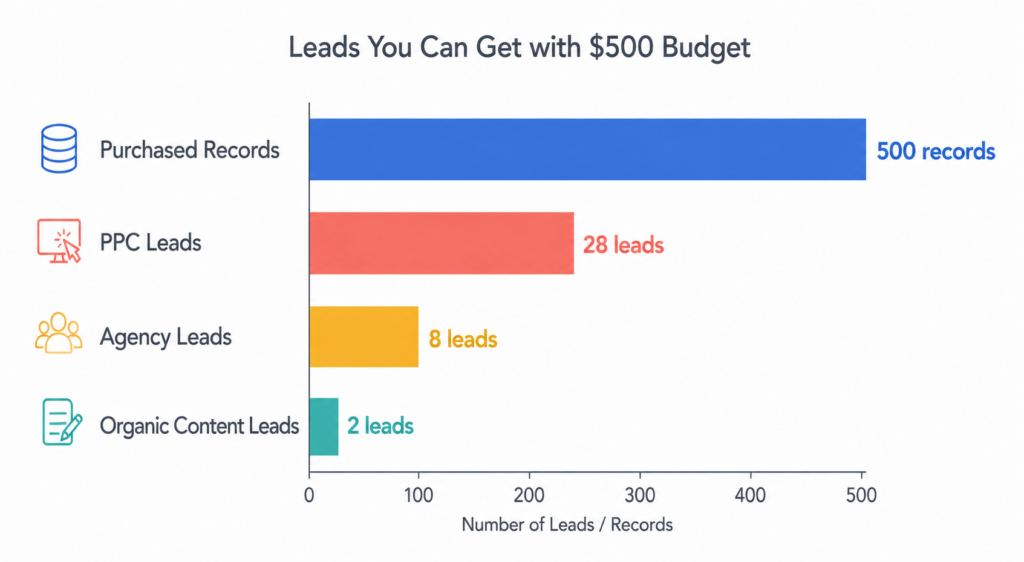
Once you know which product you’re buying, the pricing model usually falls into one of four buckets.
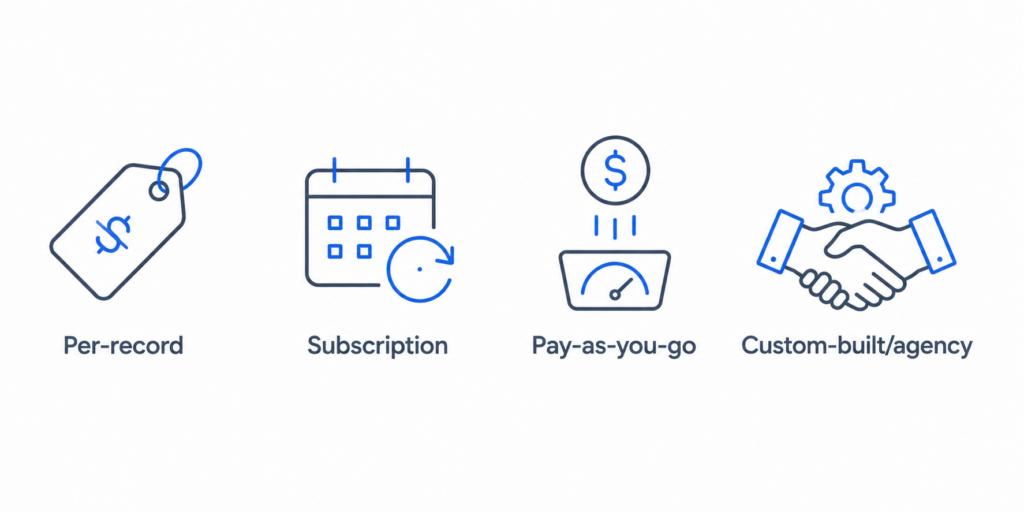
| Model | How it’s priced | Typical range | Best for |
| Per-record (data tools) | Pay per verified contact or credit | $0.01 to $2.50 per record | Teams building their own lists at volume |
| Subscription (database access) | Flat monthly seat fee plus credits | $49 to $150+ per user, per month | Ongoing prospecting with a defined team |
| Pay-as-you-go (per generated lead) | Pay only for qualified leads delivered | $30 to $650 per lead | Testing a channel before committing budget |
| Custom-built / agency retainer | Monthly fee for managed lead generation | $2,000 to $14,000+ per month | Teams that want leads delivered, not raw data |
A few notes on where these numbers come from. Per-record pricing at the low end reflects verified-email providers charging around a cent per contact, while providers bundling phone numbers and waterfall enrichment push closer to the $1 to $2.50 range per record. Subscription pricing is what you’ll see from most modern sales intelligence platforms, where the seat fee is really just the entry point and actual cost scales with how much data your team pulls. Pay-as-you-go sits in the range multiple sources report for generated leads, with wide swings by industry and channel. Agency retainers cover full-service lead generation, research, outreach, and appointment setting bundled together, which is why the price jumps so much higher than either of the data-only models.
Worth calling out: the subscription model is the one most likely to surprise you after the fact. The advertised seat price is rarely the full story. Credits run out mid-month, phone number lookups burn through allowances far faster than email lookups, and unused credits often don’t roll over. A team that budgets for the sticker price and doesn’t watch usage can end up paying two to three times the advertised rate once overages and add-ons are added in. If you’re comparing subscription tools, ask specifically how credits are consumed (per email, per phone number, per export) before you commit, not after your first invoice.
What is an ideal cost per lead?
There’s no universal “good” CPL. The right number depends entirely on what a customer is worth to you. The formula most teams use:
Target CPL = Customer lifetime value × target gross margin × close rate
Here’s a worked example. Say your average customer is worth $50,000 over their lifetime, your gross margin is 70%, and your sales team closes 5% of qualified leads.
$50,000 × 0.70 × 0.05 = $1,750
That’s your ceiling. A $1,750 cost per lead sounds enormous next to a “$237 average,” but for this business it’s completely sustainable, because the lifetime value backs it up. Flip it around: if your average deal is worth $2,000 and you close 10% of leads, your target CPL might be closer to $140, and paying $400 a lead would sink you even though it’s well within “normal” industry ranges.
The mistake most teams make is benchmarking against an industry average instead of their own math. A $500 CPL isn’t good or bad on its own. It’s only good or bad relative to what that lead is worth to your business once it closes.
This is also why industry-wide benchmarks swing so hard. First Page Sage’s data shows blended CPL running from around $91 in e-commerce up to nearly $982 in higher education, a roughly 10x spread. That’s not one market being ripped off and the other getting a deal, it reflects wildly different deal sizes and lifetime values. A $900 lead is fine when the customer is worth $50,000 a year. A $900 lead would be a disaster for a business selling a $200 product. Always run your own numbers before deciding whether a quoted price is reasonable.
Is it worth paying for B2B leads?
Honestly, sometimes yes, sometimes no. Here’s how to tell which side you’re on.
Paying for leads tends to work when:
- Your customer lifetime value comfortably covers the cost (the 3:1 LTV to CAC ratio is the standard sanity check)
- You need pipeline now and don’t have months to build organic channels
- You have a defined ICP tight enough that a purchased list or paid campaign can actually target it
- You have the infrastructure (a CRM, a follow-up process, sales capacity) to actually work the leads you’re paying for
Paying for leads tends to backfire when:
- You buy a list without a clear ICP and hope volume makes up for targeting
- You don’t verify the data first and eat the bounce-rate and deliverability damage instead
- Your deal size is too small to justify anything above a very low CPL
- You treat the purchase as the finish line instead of the start of a nurture sequence
The honest version of this section, the one a lot of pricing pages skip, is that plenty of people who complain about B2B leads online got burned buying an unverified list with no targeting and expecting it to convert like a warm referral. That’s not really a “B2B leads don’t work” problem, it’s a “garbage in, garbage out” problem. The teams getting real return from purchased leads are almost always pairing decent data with a real qualification and follow-up process, not just spending money and waiting.
Can you get B2B email leads for free?
Sort of. There’s no such thing as a free lead with zero cost, but there are routes where the cost is your time instead of your budget.
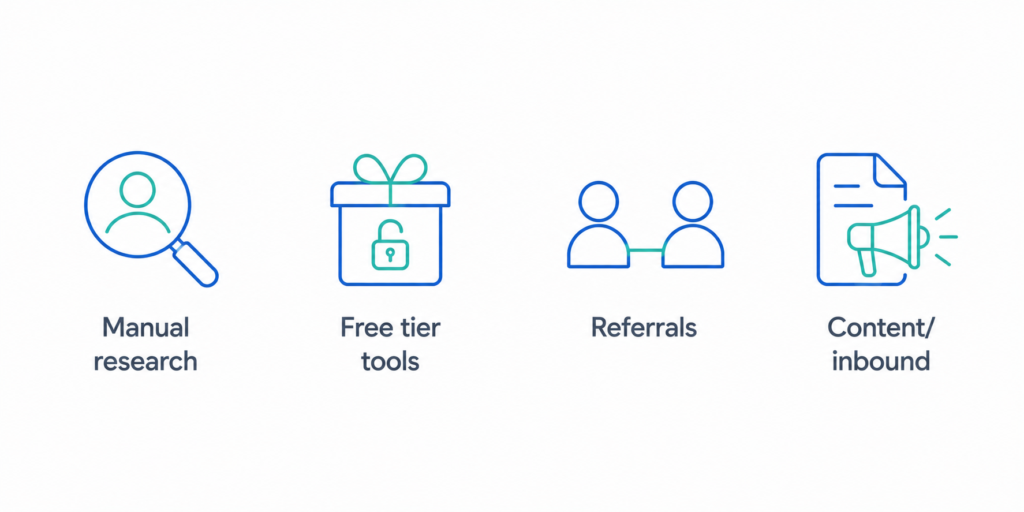
Manual LinkedIn and company research
You can build a small, highly targeted list by hand, researching prospects on LinkedIn, checking company websites, and cross-referencing with public sources. It costs nothing but hours, and realistically it’s slow, a few dozen well-researched contacts per person per day is a fair pace.
Free tiers of data tools
Most enrichment platforms offer a limited free plan, a capped number of credits per month or a small daily search allowance. Fine for testing a tool or building a small starter list, not a real substitute for volume.
Referrals and existing networks
Free in dollar terms, and often the highest-converting source there is, but it doesn’t scale on demand. You can’t decide on Monday that you need 200 referral leads by Friday.
Content and inbound
Publishing content that ranks and draws in the right audience is genuinely free of ad spend, but it’s not free of effort, and it takes months before it produces a meaningful lead volume. [See our guide to building a B2B lead list manually →] for a full breakdown of the manual route, including how many hours it realistically takes per qualified contact.
The honest math: free lead sources trade dollars for hours. If your time is genuinely idle and you’re prospecting a narrow, high-value list, that trade can make sense. If you’re trying to hit real pipeline targets on a deadline, the hours add up fast, and at some point paying for verified data or a generation channel is cheaper than the opportunity cost of doing it all by hand.
FAQ
How much does it cost to send 10,000 emails?
Sending itself is cheap. Most cold email and marketing platforms charge based on your plan tier rather than per email, so 10,000 sends might run anywhere from $30 to $150 a month depending on the tool and whether you need dedicated sending infrastructure. The real cost isn’t the sending, it’s list quality. A cheap send to an unverified list produces bounces that damage your sender reputation, which costs you far more in future deliverability than you saved on the sending tool.
What is the rule of 7 in B2B?
The rule of 7 is the idea that a prospect usually needs around seven exposures to your brand or message, across email, LinkedIn, and other channels, before they take action. In pricing terms, it’s a reminder that the cost of a single email send isn’t the real cost of a lead, the real cost includes the full sequence it takes to get a reply.
What is the 95-5 rule?
The 95-5 rule says that at any given moment, roughly 95% of your target market isn’t actively ready to buy, only about 5% are in-market right now. This matters for pricing because it explains why chasing the cheapest possible CPL on in-market buyers alone caps your volume. Reaching the other 95% usually means investing in awareness and nurture, which shows up as a different, often lower, cost per contact but a longer path to revenue.