Blog
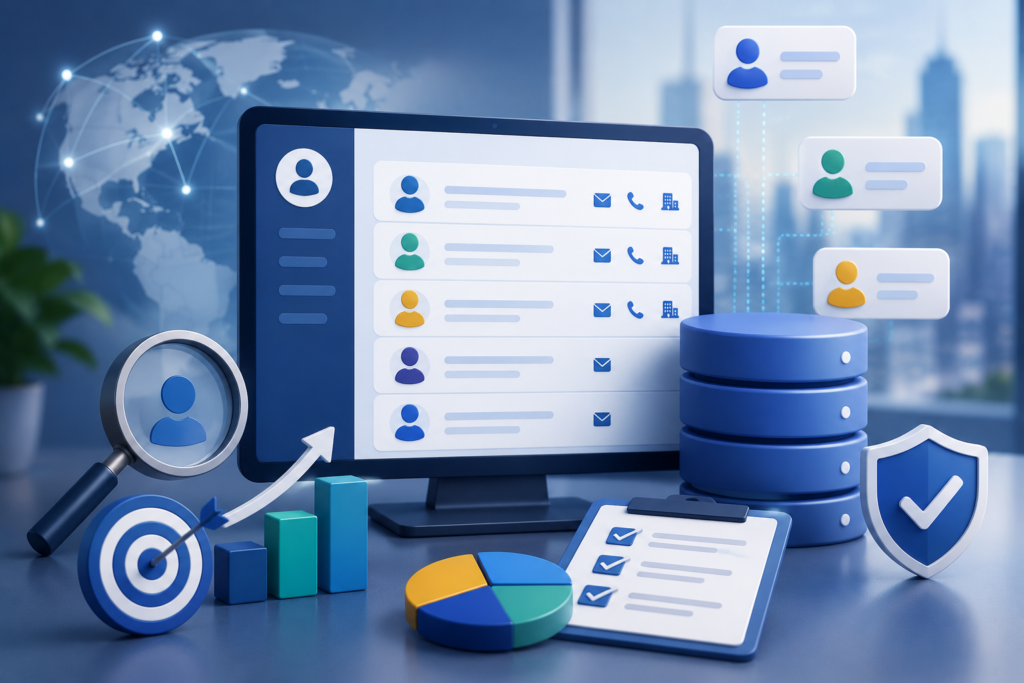
Finding the right prospects is one of the biggest challenges in B2B sales. Even the best sales pitch won’t generate results if it’s sent to the wrong people or outdated contact information.
That’s where a B2B contact database becomes valuable. Instead of spending hours searching company websites or LinkedIn profiles, businesses can access verified contact information for decision-makers across different industries, locations, and company sizes.
Sales teams, recruiters, marketing agencies, and event organisers all use B2B contact databases to find the right people faster. Instead of spending hours searching for contact information, they can focus on starting conversations with potential customers.
In this guide, we’ll explain what a B2B contact database is, how it works, what information it includes, its benefits, common use cases, and how to choose the right provider for your business.
What Is a B2B Contact Database?
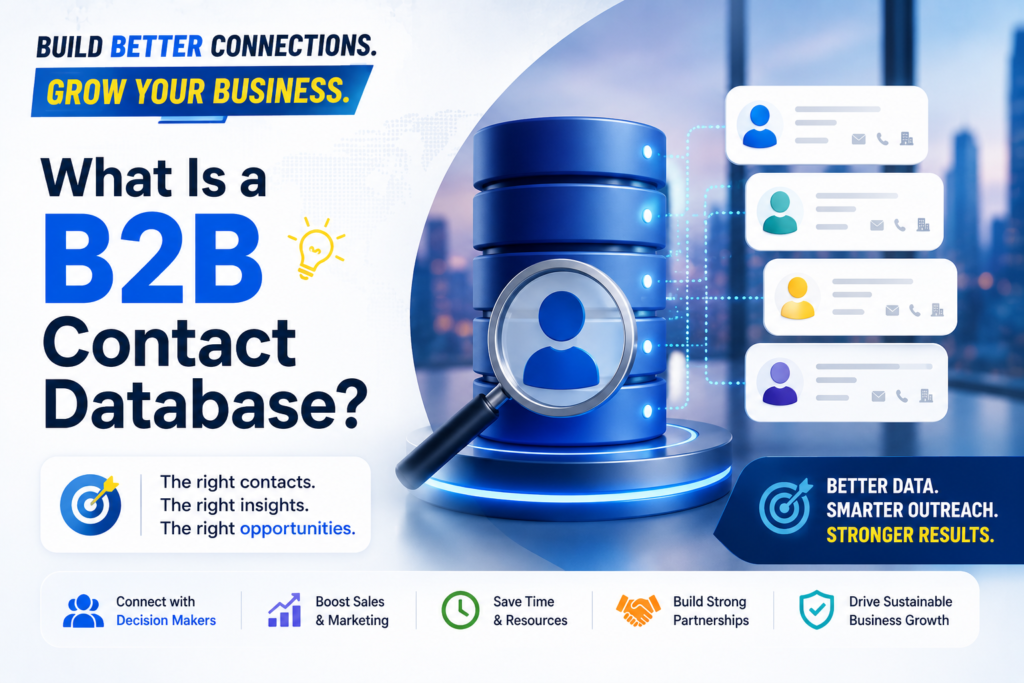
A B2B contact database is a collection of business contact information that helps companies identify and connect with potential customers. These databases typically contain details about professionals working in different organisations, making it easier for sales and marketing teams to find the right people without researching every company manually.
Depending on the provider, a B2B contact database may include thousands or even millions of business contacts across multiple industries and countries. Some providers focus on specific regions or sectors, while others offer global coverage with advanced filtering options.
A typical B2B contact database may include:
- First and last name
- Job title
- Company name
- Business email address
- Phone number
- LinkedIn profile
- Industry
- Company size
- Revenue range
- Business location
- Company website
Many providers also include firmographic and technographic data, allowing businesses to build highly targeted prospect lists based on their ideal customer profile.
How Does a B2B Contact Database Work?
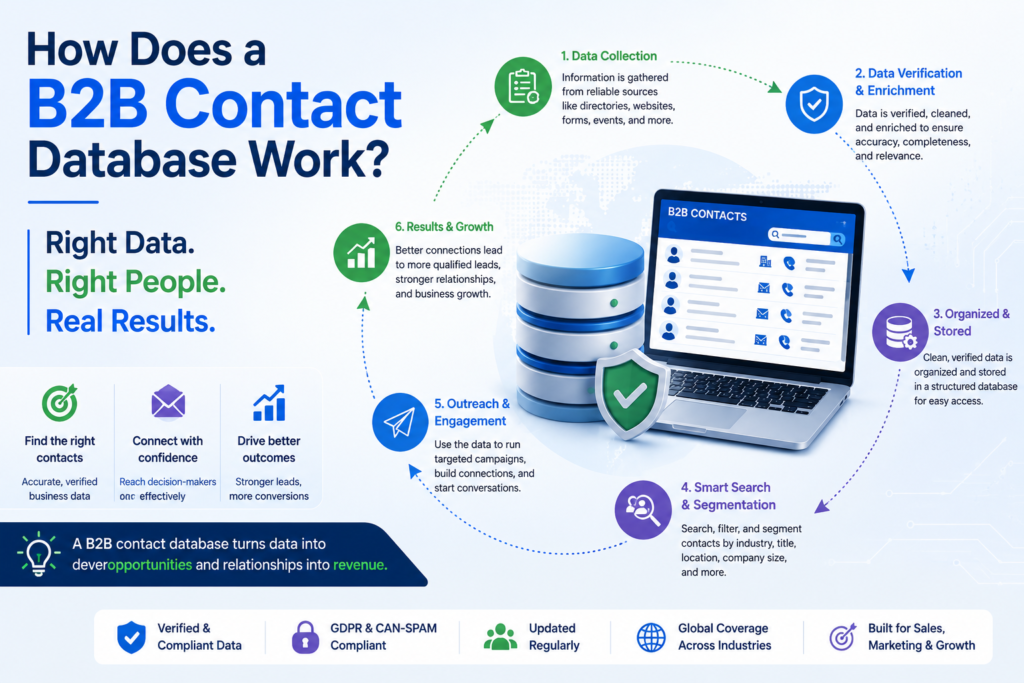
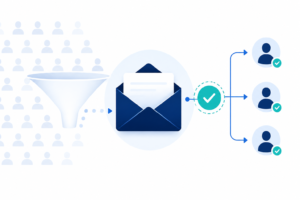
A B2B contact database gathers business information from various sources, organises it into searchable records, and regularly updates the data to improve accuracy.
When a user searches the database, they can apply filters to narrow the results. For example, a software company selling to manufacturing businesses in the United States can search for Operations Directors at companies with more than 500 employees.
Instead of receiving thousands of unrelated contacts, the database returns a list that closely matches those requirements.
Most modern databases also allow users to filter contacts by:
- Industry
- Country
- State or city
- Job title
- Department
- Company size
- Annual revenue
- Seniority level
- Technologies used
- Employee count
These filters help businesses create smaller, more relevant prospect lists instead of relying on broad databases that include many contacts outside their target audience.
What Information Does a B2B Contact Database Include?
Not every provider offers the same level of detail. Some databases only provide business email addresses, while others include additional information that helps sales teams personalise their outreach.
Contact Information
The basic information usually includes the person’s name, business email address, company name, and job title. This allows sales teams to identify who they should contact within an organisation.
Company Information
Many databases also provide company-level details such as industry, employee size, annual revenue, headquarters location, and website.
This information helps businesses qualify prospects before starting outreach.
Decision-Maker Details
One of the biggest advantages of a quality B2B contact database is the ability to search for specific decision-makers.
Rather than contacting a general company inbox, businesses can identify professionals such as:
- CEOs
- Founders
- Marketing Directors
- HR Managers
- IT Directors
- Finance Managers
- Procurement Heads
- Sales Leaders
Reaching the right person often leads to better response rates than sending emails to shared addresses like info@ or support@.
Additional Business Data
Some providers go beyond basic contact details by including additional business insights.
These may include:
- LinkedIn profile links
- Company growth information
- Funding details
- Technology stack
- Company size trends
- Hiring activity
- Intent signals
These additional fields are especially useful for larger sales teams that want to prioritise high-value prospects.
Benefits of Using a B2B Contact Database
Building a prospect list manually can take hours or even days. A B2B contact database speeds up this process by giving businesses quick access to relevant contacts.
Here are some of the biggest benefits.
Saves Time
Researching hundreds of companies individually isn’t practical for most sales teams.
A searchable database allows users to generate targeted prospect lists within minutes instead of spending hours collecting contact information manually.
Improves Targeting
Instead of emailing every company in a particular industry, businesses can focus on organisations that match their ideal customer profile.
Filtering contacts by job title, company size, industry, or location makes outreach much more relevant.
Supports Better Personalisation
Additional business information helps sales teams personalise emails with company-specific details rather than sending generic messages to every prospect.
Personalised outreach generally performs better because it feels more relevant to the recipient.
Helps Build a Predictable Sales Pipeline
Consistent prospecting depends on having a reliable source of new business contacts.
A quality B2B contact database gives sales teams a steady flow of prospects instead of relying entirely on referrals or inbound enquiries.
Works Across Different Industries
B2B contact databases aren’t only used by software companies.
They also support:
- Recruitment agencies
- Marketing agencies
- Event organisers
- Financial service providers
- Consulting firms
- Manufacturing businesses
- Healthcare suppliers
- Education providers
Any business selling products or services to other businesses can benefit from targeted contact data.
Common Uses of a B2B Contact Database
A B2B contact database can support much more than cold email campaigns. Businesses across different industries use contact data to reach potential customers, build partnerships, and generate new opportunities.
Here are some of the most common ways businesses use a B2B contact database.
Sales Prospecting
Sales teams use contact databases to identify decision-makers before starting outreach. Instead of contacting a general company email address, they can reach professionals who are directly involved in purchasing decisions.
With the right filters, it’s possible to build a list of prospects that closely match your ideal customer profile.
Email Marketing
A targeted email campaign starts with the right audience.
Businesses often use B2B contact databases to build lists based on industry, company size, location, or job title. This allows them to create more relevant campaigns instead of sending the same message to every contact.
Before launching any campaign, it’s always a good idea to verify the email addresses and follow the email marketing regulations that apply to your target market.
Event Promotion
Companies organising webinars, conferences, and trade shows often need to reach professionals within a specific industry.
A B2B contact database makes it easier to promote events to the right audience without spending weeks building attendee lists from scratch.
Recruitment
Recruiters and staffing agencies also use business contact databases to connect with hiring managers, HR leaders, and department heads.
This helps them introduce candidates or recruitment services to organisations that match their areas of expertise.
Market Expansion
When entering a new country or industry, businesses first need to identify potential customers.
A B2B contact database provides a faster way to understand the market and build a list of companies that match their target audience.
How to Choose the Right B2B Contact Database
Not every database offers the same level of quality. Before choosing a provider, compare more than just the number of contacts available.
Here are a few factors worth considering.
Data Accuracy
Outdated contact information leads to higher bounce rates and wasted outreach efforts.
Ask how often the provider updates its database and whether the records are verified before delivery.
Search Filters
Good filtering options help you build smaller, more relevant prospect lists.
Look for filters such as:
- Industry
- Job title
- Country
- State or city
- Company size
- Revenue
- Employee count
- Department
The more precise the filters, the easier it becomes to reach the right audience.
Coverage
Some providers specialise in certain countries or industries, while others offer global databases.
Choose a provider whose coverage matches the markets you want to target.
Pricing Model
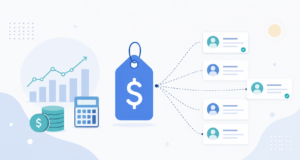
B2B contact database providers usually follow one of three pricing models.
One-time purchase
You pay for a customized list without a recurring subscription.
Subscription
You receive ongoing access to a searchable database for a monthly or annual fee.
Credit-based
You purchase credits that can be exchanged for contact records whenever you need them.
The right option depends on how often your business purchases prospect data.
Customer Support
Reliable customer support becomes important when you need custom targeting, replacements, or help understanding the data.
A provider that responds quickly and answers questions clearly is often easier to work with over the long term.
Best B2B Contact Database Providers
There are many companies offering business contact data, but each one is designed for a different type of customer.
1. EmailProLeads
Best for: Businesses looking for targeted B2B contact databases with a one-time payment option.
EmailProLeads focuses on customized business contact databases instead of subscription software. Businesses can request contacts based on industry, country, job title, company size, and other targeting criteria.
This approach works well for companies that run occasional outreach campaigns and don’t want to pay monthly subscription fees for features they may never use.
Pros
- One-time payment option
- Custom targeting
- Suitable for agencies, startups, recruiters, and event organisers
Cons
- Does not include built-in sales engagement tools or CRM features.
2. ZoomInfo
Best for: Enterprise sales teams.
ZoomInfo combines contact data with sales intelligence, buyer intent, company insights, and CRM integrations.
It’s a powerful platform for large outbound sales teams, but the pricing can be difficult to justify for smaller businesses.
Pros
- Large business database
- Advanced sales intelligence
- Strong CRM integrations
Cons
- Premium pricing
3. Apollo
Best for: Small and medium-sized sales teams.
Apollo combines contact data, prospecting, and outreach tools within one platform.
Businesses can search for contacts, send email sequences, and manage outreach without switching between multiple applications.
Pros
- Free plan available
- Outreach tools included
- Easy to get started
Cons
- Credit limits apply on lower plans.
4. Cognism
Best for: European prospecting.
Cognism is well known for its strong coverage across Europe and its focus on compliant business data.
It is widely used by organisations selling into UK and European markets.
Pros
- Strong European database
- Mobile numbers available
- Good compliance practices
Cons
- Custom pricing
5. UpLead
Best for: Verified business contact data.
UpLead focuses on delivering verified business contacts with advanced filtering and enrichment features.
Its straightforward pricing makes it popular with growing sales teams.
Pros
- Verified contacts
- Easy filtering
- Simple pricing
Cons
- Monthly export limits.
6. Lead411
Best for: Businesses looking for contact data with buyer intent information.
Lead411 combines business contacts with company insights and sales triggers, helping sales teams identify potential opportunities.
Pros
- Buyer intent data
- Competitive pricing
Cons
- Smaller international database than some competitors.
7. Hunter
Best for: Finding professional email addresses.
Hunter is ideal for businesses that need to locate and verify individual business email addresses rather than purchase complete databases.
Pros
- Easy email search
- Built-in verification
Cons
- Not designed for buying large contact databases.
8. Data Axle
Best for: Large business databases.
Data Axle provides business and consumer data for organisations running large marketing and prospecting campaigns.
Pros
- Large database
- Broad industry coverage
Cons
- Pricing available by quotation only.
B2B Contact Database Providers Compared
Each provider has its own strengths. Some are designed for businesses that only need contact data, while others combine prospecting, CRM integrations, email outreach, and sales intelligence in one platform.
The table below gives a quick comparison before you make a decision.
| Provider | Best For | Pricing Model | Custom Targeting | Built-in Prospecting Tools |
| EmailProLeads | One-time targeted contact databases | Custom quote | ✔ Yes | ✖ No |
| ZoomInfo | Enterprise sales intelligence | Custom quote | ✔ Yes | ✔ Yes |
| Apollo | Sales prospecting and outreach | Monthly subscription | ✔ Yes | ✔ Yes |
| Cognism | European B2B prospecting | Custom quote | ✔ Yes | ✔ Yes |
| UpLead | Verified business contacts | Monthly subscription | ✔ Yes | Limited |
| Lead411 | Intent-based prospecting | Monthly subscription | ✔ Yes | ✔ Yes |
| Hunter | Email finding and verification | Freemium | Limited | Limited |
| Data Axle | Large business databases | Custom quote | ✔ Yes | ✖ No |
Final Thoughts
A B2B contact database can be a valuable resource for businesses that want to reach the right decision-makers without spending hours researching contacts manually. Whether you’re generating sales leads, promoting an event, recruiting talent, or expanding into a new market, having access to accurate business contact information can make your outreach more efficient.
The best provider depends on how your business works. If you regularly prospect and need sales intelligence, a subscription platform may be the right choice. If you only need targeted business contacts for occasional campaigns, a provider that offers customised databases with a one-time payment option may be a more practical solution.
Before making a decision, compare providers carefully, review their data quality, understand their pricing model, and choose the option that best matches your budget and outreach goals.
Frequently Asked Questions
What is the difference between a B2B contact database and a B2B email list?
A B2B email list usually contains business email addresses and a few basic details such as names and company information. A B2B contact database is more comprehensive and may include phone numbers, LinkedIn profiles, company size, revenue, industry, location, and other business information. Many databases also allow users to search and filter contacts based on specific criteria.
Who uses a B2B contact database?
B2B contact databases are used by businesses that need to connect with other businesses. Common users include sales teams, marketing agencies, recruiters, consultants, event organisers, SaaS companies, manufacturers, and financial service providers.
Are B2B contact databases legal?
Yes, but businesses must use the data responsibly and follow the regulations that apply in the countries where they operate. Before purchasing a database, it’s worth asking the provider how the information is collected and how often it is updated.
How often should a B2B contact database be updated?
Business information changes regularly as people change jobs, companies grow, and organisations restructure. A reliable provider should review and refresh its database on a regular basis to help maintain data quality.
What should I look for before buying a B2B contact database?
Instead of comparing providers based only on the number of contacts they offer, consider the quality of the data, available search filters, geographic coverage, pricing model, customer support, and replacement policy. A smaller, well-targeted database often delivers better results than a much larger list filled with irrelevant contacts.
Can small businesses benefit from a B2B contact database?
Absolutely. Small businesses often have limited time and resources for prospecting. A targeted contact database can help them identify potential customers more quickly and focus their efforts on businesses that match their ideal customer profile.