Blog
Choosing between a one-time email list purchase and a subscription can be confusing. Both options have their advantages, but the best choice depends on your budget, marketing goals, and how often you need updated contact data. A lower price doesn’t always mean better value, especially if the licence limits how you can use the list.
In this guide, we’ll explain the costs, compare both pricing models, discuss the licence terms, and help you choose the option that fits your needs.
First, know which product you’re actually pricing
One of the biggest reasons people get confused about pricing is that they mix up email list providers with email marketing software. While they sound similar, they serve completely different purposes.
Email list providers sell contact data, including verified email addresses, names, job titles, company details, and sometimes phone numbers. With many providers, you can either buy a list once or sign up for a subscription that gives you ongoing access to fresh data. In simple terms, you’re paying for the contact database itself.
Email marketing software, on the other hand, doesn’t provide contact data. These platforms help you create, send, and track email campaigns using the contacts you already have. Most email marketing tools charge a monthly or annual subscription because you’re paying for the software, hosting, deliverability, and regular feature updates.
The confusion usually happens when these two services are treated as the same product. They aren’t. Email marketing software is almost always subscription-based because you’re using an online platform. Email list data, however, can often be purchased as a one-time download, allowing you to own and reuse the data according to the provider’s licence terms.
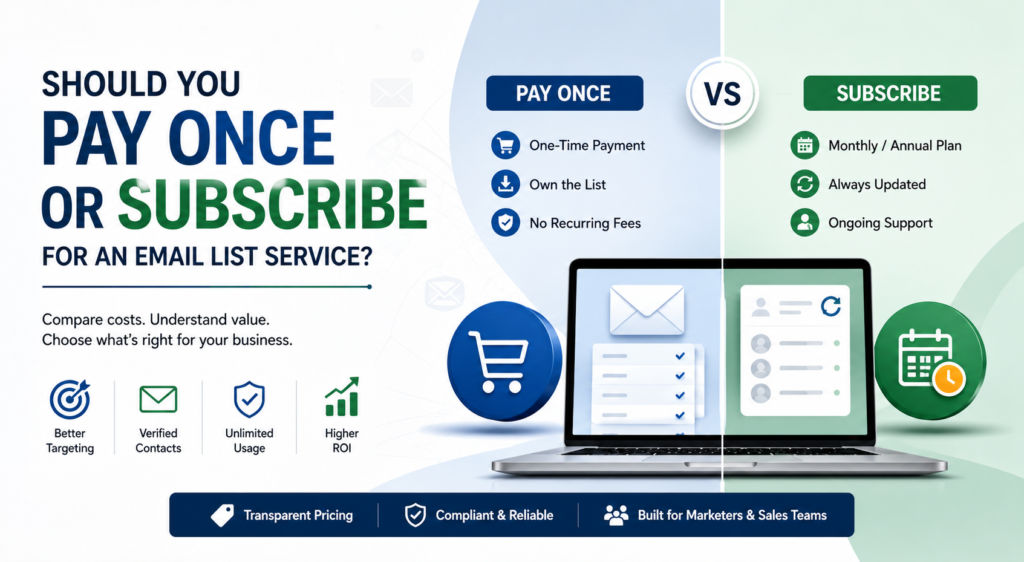
One-time payment vs subscription: side-by-side
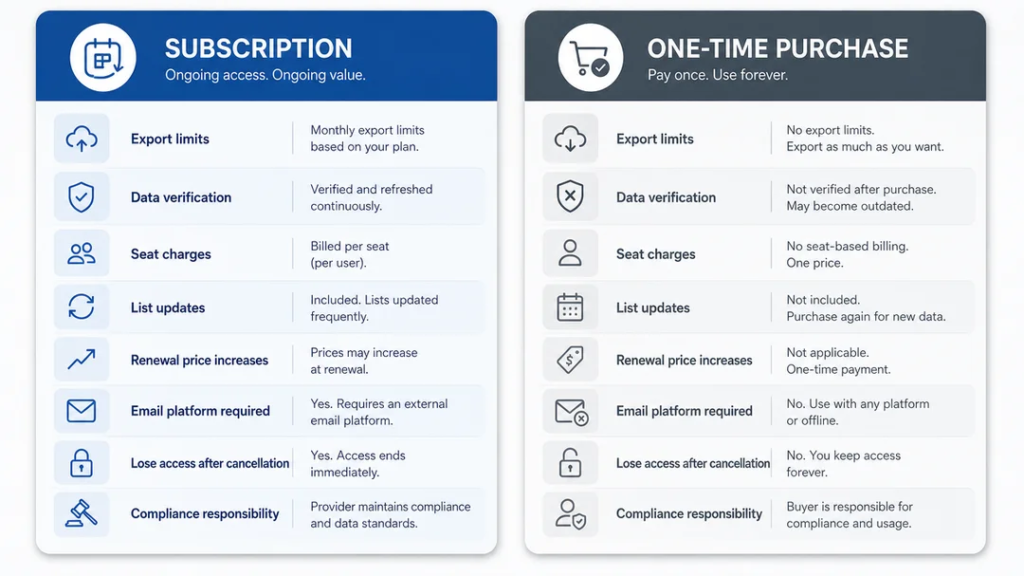
| One-time payment (list data) | Subscription (data or software) | |
| Upfront cost | Higher single payment (e.g., $99–$500 for large verified databases) | Low entry price ($15–$300/month), rises with usage or seats |
| Cost over 3 years | Fixed — the first payment is the last | Compounds; data platforms commonly run $1,200–$3,000+ per year |
| Ownership | You own the file; usable offline, in any CRM or sending tool | Access ends when payments end; exports are often limited by credits |
| Usage limits | Depends on license: single-use, multi-use, or unlimited (check before buying) | Metered by monthly credits, seats, or contact caps |
| Data freshness | Frozen at delivery; decays unless the provider offers refreshes or you re-verify | Continuously updated by the platform |
| Support | Varies; often delivery-focused | Ongoing support is usually included |
| Best for | Defined campaigns, stable target markets, budget certainty, agencies reselling outreach | Sales teams prospecting daily, fast-changing industries, teams needing integrations |
The math: what each model really costs a US small business
Here’s a realistic three-year comparison for a small business that needs roughly the same pool of US business contacts either way:
| Cost item | One-time purchase | Data subscription |
| Year 1 | $99–$500 one-time (e.g., EmailProLeads’ Lifetime Plan is $99 for unlimited lists) | $1,200–$3,000 (ZoomInfo-class platforms; lighter tools like Lusha or Snov run roughly $340–$350/year on entry plans) |
| Years 2–3 | $0 required; optional re-verification (~$0.003–$0.01 per email with bulk verifiers) | Another $2,400–$6,000, and per-contact credits often shrink at renewal |
| 3-year total | ~$99–$700 | ~$3,600–$9,000+ |
The decision often comes down to how you’ll actually use the data. If a one-time email list gives you enough verified contacts to reach your target audience, it can be a more cost-effective choice than paying for a subscription month after month. On the other hand, a subscription makes sense if your team is constantly looking for new prospects, needs regularly updated contact information, or relies on features like CRM enrichment. If you only need the data occasionally, paying for an ongoing subscription may end up costing more than it’s worth.
The license is the fine print that decides everything
The price of an email list doesn’t always reflect its actual value. Two lists may cost the same, but one could give you far more flexibility than the other. That’s because the licence determines how many times you can use the data after you purchase it.
Single-use licence
A single-use licence allows you to send one campaign to the contacts on the list. It’s usually the cheapest option, but it may not be a good choice if you plan to reach the same audience more than once. Some providers also include tracking records to identify unauthorised reuse.
Multi-use licence
A multi-use licence lets you use the list multiple times, either for a set number of campaigns or within a fixed period, such as 12 months. It offers more flexibility than a single-use licence and is generally priced somewhere in the middle.
Unlimited-use licence
An unlimited-use licence gives you the freedom to keep and reuse the list without paying additional fees or worrying about expiry dates, as long as you follow the provider’s terms. While many companies charge significantly more for this type of licence, EmailProLeads includes unrestricted ownership with every one-time purchase. That means there are no recurring charges or usage limits. You can also explore our United States email lists to see the data fields included.
Before you buy, always ask for the licence terms in writing. If a provider isn’t willing to clearly explain what you’re allowed to do with the data, it’s best to assume the list comes with limited usage rights.
Hidden costs on both sides (nobody’s invoice is clean)
Hidden Costs to Consider
The price you see isn’t always the full cost. Whether you choose a subscription or a one-time purchase, there are additional expenses that can affect your overall budget.
Hidden Costs of Subscription Plans
Export limits
Many platforms advertise unlimited access, but the number of contacts you can export each month is often capped. If you need more records, you’ll usually have to upgrade to a higher-priced plan.
Extra user fees
As your team grows, so does the cost. Adding another salesperson or team member often means paying for an additional seat, which can quickly increase your monthly bill.
Higher renewal prices
Introductory offers don’t always last. It’s common for subscription prices to increase when it’s time to renew, so your long-term costs may be higher than expected.
Losing access when you cancel
With most subscription services, your access ends as soon as you stop paying. Any contacts you didn’t export before cancelling are no longer available.
Hidden Costs of One-Time Email Lists
Data becomes outdated over time
Business contact information changes regularly as people switch jobs or companies. A list that is accurate today won’t stay that way forever. Before launching a major campaign, it’s a good idea to verify the data again or buy from a provider that regularly updates and verifies its database.
Email verification isn’t optional
Sending emails to outdated or invalid addresses can increase bounce rates and damage your sender reputation. That’s why verifying your list before sending is an important step, especially for larger campaigns.
You’ll still need an email marketing platform
Buying an email list only gives you the contact data. You’ll still need an email marketing platform or SMTP service to send your campaigns, so factor those costs into your budget.
Compliance is your responsibility
No matter where you buy your list, you’re responsible for following the applicable email marketing laws. In the United States, the CAN-SPAM Act requires you to include a working unsubscribe link, honour opt-out requests, use accurate sender information, and avoid misleading subject lines. If you’re contacting people in the European Union, you’ll also need to consider GDPR requirements, which are generally more restrictive.
When a subscription is genuinely the better choice
A one-time email list works well for many businesses, but it’s not the right fit for everyone. If your sales and marketing teams rely on fresh data every day, a subscription can provide better long-term value.
A subscription is usually the better option if:
- Your sales team is prospecting every day. If you’re constantly searching for new leads, regularly updated contact information and CRM integrations can save time and improve efficiency.
- Your target audience changes quickly. Industries like startups or newly registered businesses evolve rapidly. A subscription gives you access to updated records without having to purchase new lists repeatedly.
- You need more than contact data. Many subscription platforms include additional features such as buyer intent data, technographics, sales workflows, and CRM integrations that aren’t available with a standard email list.
- You prefer ongoing support and automatic updates. Instead of managing data verification yourself, a subscription service can handle regular updates and maintenance, ensuring your database stays as accurate as possible.
When paying once wins
A one-time email list is often the better choice if you don’t need new contacts every day and prefer to own the data instead of paying an ongoing subscription.
It can be a good fit if:
- You have a clearly defined target audience. If you’re trying to reach a specific group, such as US accounting directors, pool builders, or small business owners, buying a targeted list can be more cost-effective than paying for a subscription. You can explore different industries in our USA email lists catalogue.
- Your marketing is campaign-based. Businesses that send emails for product launches, seasonal offers, webinars, or event invitations usually don’t need continuously updated contact data.
- You want predictable costs. With a one-time purchase, you pay once and know exactly what you’re spending. There are no monthly renewals or subscription fees to factor into your budget.
- You manage multiple clients. Agencies and freelancers often work with different client databases. A one-time purchase helps avoid the extra costs that come with per-user or per-seat subscription plans.
- You’d like to test email marketing first. If you’re unsure whether a particular audience is right for your business, start with a free USA email database sample. It allows you to check the data quality and see how your campaigns perform before investing in the full list.
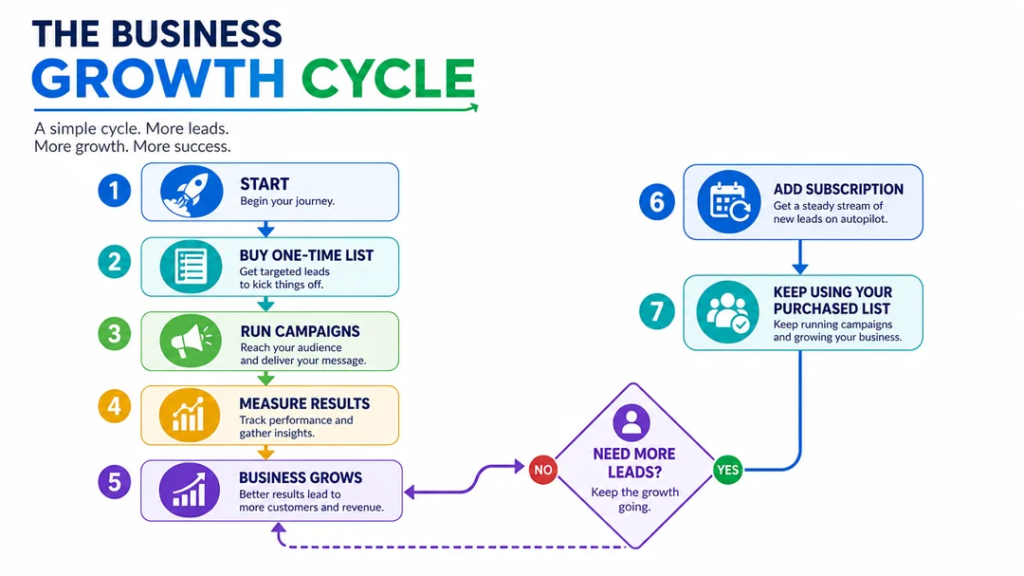
Can you switch between models?
Absolutely. In fact, many businesses find that using both options at different stages works best.
A practical approach is to start with a one-time email list. It gives you the opportunity to test your campaigns, measure response rates, and identify which audience segments generate the best results without committing to a monthly subscription.
As your business grows and your prospecting needs increase, you can add a subscription service to access newly updated contacts and discover fresh leads. This way, your purchased email list remains a valuable asset, while the subscription helps you expand your database over time.
One advantage of this approach is that you continue to own the contacts you’ve already purchased. With many subscription platforms, access to records ends when you cancel your plan, especially if you haven’t exported them beforehand. To avoid losing valuable data, always download any contacts you’re entitled to keep before your subscription expires or is cancelled.
Decision checklist (60 seconds)
- Am I buying data or software? (Software → subscription. Data → keep reading.)
- Is my target market stable for 12+ months? (Yes → one-time favors you.)
- Will I contact this audience more than once? (Yes → demand an unlimited-use license in writing.)
- Do I prospect new accounts daily? (Yes → a subscription’s refresh rate earns its fee.)
- Have I priced 3 years of the subscription against one purchase plus re-verification? (Do the table above with your own numbers.)
Frequently asked questions
Is it better to pay once or subscribe for an email list service?
Pay once when you’re buying list data for a stable target market and can get an unlimited-use license — the one-time cost is usually recovered within the first quarter versus a subscription. Subscribe when you need continuously refreshed data, daily prospecting tools, or software features like automation and CRM sync.
Are there reliable email list services with a one-time fee?
Yes. EmailProLeads offers verified US business and consumer email databases with a one-time payment and full ownership — no recurring fees or usage limits — starting at $99 for the Lifetime Plan. Compare that with data platforms such as ZoomInfo, Lusha, or Snov, which charge roughly $340 to $3,000+ per year on subscription plans.
What are the hidden costs of a one-time email list purchase?
The main ones are data decay (B2B contacts degrade around 2–3% per month), periodic re-verification costs, and the separate cost of a sending platform. A provider that verifies its database monthly and discloses the update date minimizes the first two.
What’s the difference between a single-use and unlimited-use email list license?
A single-use license permits one campaign to the list, and providers often seed tracking addresses to enforce it. An unlimited-use license transfers the file to you permanently with no reuse restrictions. Unlimited licenses commonly cost 2–3x single-use pricing when sold separately, so a one-time price that already includes unlimited use is materially better value.
Is it legal to email a purchased list in the US?
Yes, for commercial email under the CAN-SPAM Act, provided you use accurate sender details, a truthful subject line, a working unsubscribe mechanism, and honor opt-outs promptly. Rules differ abroad — GDPR (EU) and CASL (Canada) generally require prior consent — so segment international contacts separately.
Are lifetime deals for email list services a good investment?
They are when three conditions hold: the provider states a recent verification date, the license is unlimited-use, and the vendor has a track record of updating its database. A lifetime deal on stale or single-use data is cheap for a reason.
Can I try before choosing a payment model?
Yes — the lowest-risk path is a free sample. EmailProLeads provides a free USA email database so you can test deliverability and response quality before buying a full segment.