
Blog
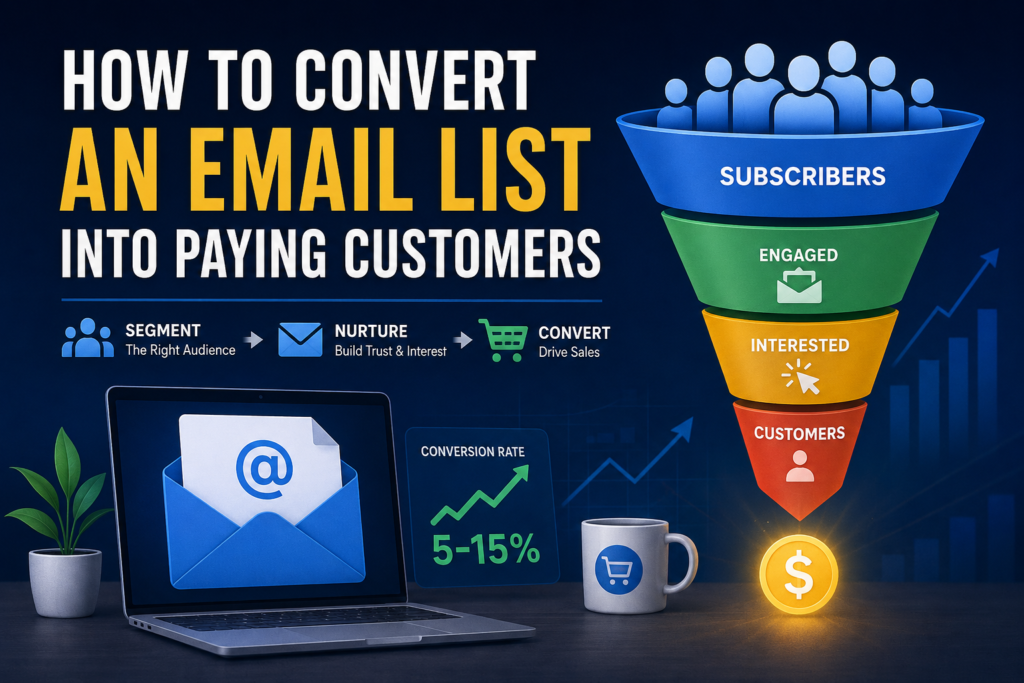
An email list earns its keep the day it produces revenue. Before that, it’s just a spreadsheet with names on it. Most businesses collect a few thousand addresses and quietly assume the conversions will follow on their own. They don’t. Turning a list into paying customers is a process, not an event — and it comes down to three moving parts: segmenting the list correctly, nurturing it with the right sequence, and giving people an easy, low-friction way to buy. Below is how each piece works, along with the conversion benchmarks you should actually expect at every stage — not the inflated numbers you’ll find in most vendor case studies.
Why Most Email Lists Never Convert
Ask most business owners why their list isn’t converting and they’ll point to the list itself — it’s too small, too old, not “warm” enough. Usually that’s not it. The real problem is that the list gets treated as one audience instead of many. A subscriber who joined five days ago and a customer who’s been buying for two years get the exact same email, on the exact same day, with the exact same offer. Neither converts as well as they could.
Converting a list is a balancing act between earning trust and asking for the sale. Lists that jump straight to “buy now” burn out fast — people unsubscribe or, worse, just stop opening. Lists that never ask for the sale generate plenty of goodwill and zero revenue. The fix isn’t complicated, even if it takes discipline to execute: value first, proof second, offer third. Applied consistently, as a system, not as a one-off campaign you run when revenue is down.
Before You Optimize: Know What You’re Working With
If you’re trying to figure out what a list you own is worth, or what you should pay for one you’re about to buy, that math lives elsewhere on this site — see how much an email list is worth and what it costs. No need to rehash it here.
What actually matters for conversion isn’t list size. It’s engagement quality. A small, highly engaged segment will consistently outperform a large, cold one — which is exactly why the first step below is segmentation, not “grow the list bigger.”
Step 1: Segment Before You Send Anything
Segmentation is the single highest-leverage move in this entire process, and it’s the one most businesses skip because it feels like extra work before you get to the “real” marketing. It isn’t extra work — it is the marketing. Businesses that combine segmentation with personalization consistently see better engagement and revenue than businesses that blast one message to everyone, and segmented campaigns typically produce around 50% more clickthroughs and 30% more opens than unsegmented sends.
Start small. Three to five core segments is plenty before you add complexity:
- Engagement — active (opened in the last 30 days) vs. inactive
- Lifecycle stage — new subscriber, window shopper (visited but hasn’t bought), cart abandoner, existing customer
- Purchase value — high spenders vs. low/no spend, so your offers match what people are actually willing to pay
Prioritize the segments tied directly to revenue signals — purchase history and cart behavior — before you get into demographic or interest-based slicing. Those matter later. They’re not where you start.
Want the deeper playbook? See Email List Segmentation Strategies That Convert for the full breakdown, including the mistakes that quietly cap your results.
Step 2: Build a Nurture Sequence That Sells Without Selling
Almost nobody buys off the first email. That’s fine — it’s what a short automated sequence is for. Once it’s built, it does the persuading on a schedule, without anyone on your team lifting a finger. Here’s a proven five-email framework:
| Day | Purpose | Example subject line |
|---|---|---|
| Day 0 | Welcome + set expectations | “You’re in — here’s what happens next” |
| Day 2 | Deliver value (no pitch) | “The one thing most people get wrong about [topic]” |
| Day 5 | Social proof / case study | “How [customer] got [result] in 30 days” |
| Day 9 | Soft offer + clear CTA | “Ready to get started? Here’s how” |
| Day 14 | Urgency / direct offer | “Last call: this closes Friday” |
Don’t skip Day 0. Welcome emails tend to land far higher engagement than any regular campaign simply because they arrive when interest is at its peak — squandering that moment is one of the most common (and most avoidable) mistakes in this whole process. Applied across a sequence like the one above, personalization typically lifts click-through rates by around 14% and conversions by around 10% compared to generic blasts.
Step 3: Write Subject Lines and CTAs That Convert
Every email in that sequence needs exactly one clear next action — not two, not three. “Get your free audit” beats “Learn more” every time, because it tells the reader precisely what happens when they click. Put your CTA above the fold, then repeat it once more near the end of the email so you’re not relying on someone scrolling back up.
Subject lines that name a specific outcome, number, or timeframe consistently beat vague ones. And when you test, test one variable at a time — subject line, send time, or CTA copy — so you actually know what moved the number instead of guessing.
Step 4: Automate the Moments That Matter Most
Not every email needs a human behind it. Transactional and trigger-based emails convert at multiples of a standard campaign, which makes them some of the highest-leverage automation you can set up:
- Abandoned cart sequences commonly convert at 5–15% — far above standard campaign rates. If you sell anything with a cart step, this is the single highest-ROI automation to build first.
- Browse abandonment (someone viewed a product but didn’t add it to cart) carries lower intent than cart abandonment, but still earns a lightweight two-email sequence.
- Free-trial or lead-magnet nurture should trigger the moment someone downloads or signs up, while their interest is at its highest point.
What Conversion Rate Should You Actually Expect?
Benchmarks vary a lot by channel and campaign type. Use the numbers below as a reality check, not a target to chase blindly — a “good” conversion rate for a B2B nurture sequence and a “good” rate for an e-commerce cart-abandonment flow are not the same number, and comparing yourself to the wrong one will make you think something’s broken when it isn’t.
| Email type | Typical conversion rate |
|---|---|
| Standard one-off campaign (all industries average) | ~0.09% |
| Automated flows (welcome/nurture sequences) | Up to ~1.7% average, 2–5% for well-optimized lists |
| B2B campaigns (longer sales cycles) | 1–3% |
| E-commerce during promotions | 3–5% |
| Abandoned cart sequences | 5–15% |
If your numbers are falling short of these ranges, the fault is almost always upstream — list quality, segmentation, or send frequency — not the offer itself. Fix the input before you rewrite the offer for the fifth time.
Converting a Purchased or Cold List Specifically
A purchased or rented list behaves differently than one you’ve grown organically. The people on it haven’t opted into a relationship with your brand specifically — they’ve never even heard of you — so trust has to be built faster and more deliberately than it does with an organic list. The groundwork for that — verification, authentication, legal requirements, deliverability — is covered in depth in our guides on building a cold email list and buying one safely.
Once that foundation is solid, the segmentation and nurture steps above are what actually turn the list into revenue. Worth saying plainly: a clean, verified, legally-sent list still won’t convert on its own. It removes the risk of deliverability and compliance problems. It doesn’t replace the sequencing described here.
Tools That Help You Convert Subscribers Into Customers
Most conversion-focused email programs run on one of a handful of platforms — Klaviyo, Mailchimp, ActiveCampaign, Brevo, HubSpot, Kit (formerly ConvertKit), Omnisend, and GetResponse come up most often for this specific use case. These tools handle the sending, automation, and segmentation mechanics — but they’re only as good as the list feeding them. A validated, properly sourced list is the input every one of these platforms depends on to hit the benchmarks above.
See the full breakdown: Best Email Marketing Platforms to Convert Subscribers Into Customers.
Frequently Asked Questions
What is the most effective way to convert email subscribers into paying customers? Segment your list by engagement and lifecycle stage, run a structured nurture sequence that leads with value before any offer, and automate high-intent moments like cart abandonment — which converts at 5–15% versus under 1% for a standard campaign.
What is a good email conversion rate? For automated flows, 2–5% is considered strong. For one-off campaigns, 1.5–3% is typical and 3–6% is excellent. Abandoned-cart sequences and other trigger-based automations often reach 5–15%.
How do I segment an email list to increase conversions? Start with three to five core segments tied directly to revenue signals: engagement level (active vs. inactive), lifecycle stage (new subscriber, cart abandoner, existing customer), and purchase value. Segmented, personalized campaigns typically see about 50% more clicks and 30% more opens than unsegmented sends.
Which email marketing platform is best for converting subscribers into customers? Klaviyo, Mailchimp, ActiveCampaign, Brevo, HubSpot, Kit, Omnisend, and GetResponse are the platforms most commonly used for this purpose, each with different strengths in automation depth and native e-commerce integration. See the full comparison to choose based on your list size and budget.
Ready to build a list that actually converts? [Try EmailProLeads free →]
